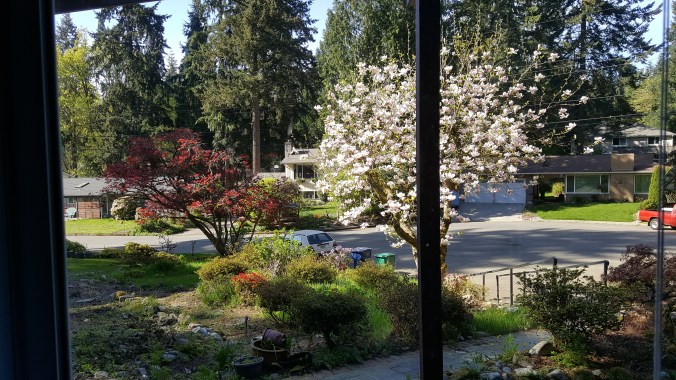
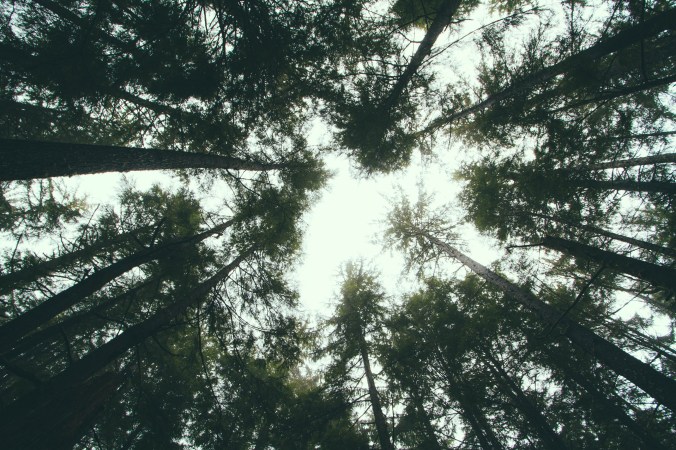
View from my livingroom window. (Ignore the trash bins and the ugly Hooptie. It’s my son’s fault they’re in the picture.)
Elegy of Beloved Disputes
The path beyond my garden
leads to my favorite tree,
bursting with flowers that
remind me of you and
it occurs to me that
you would’ve marveled at
my sweet-scented tree if you
were still alive to smell it.
The sudden reminder of
your absence steals a breath
or two from me, and then
I laugh at the absurdity.
Asthma took your laugh
from me permanently.
It is an affliction
of the lungs, you see?
Had you lived long enough to
fill your lungs with my
beloved tree,
you’d have sided with Wifey,
demanding its removal.
I don’t like confrontation,
but I’d like to think I would
have enjoyed that argument.
***
Every morning on report card day, from kindergarten to third grade, momma would sing this song to me while I was eating my cereal. It was hilarious. It was terrifying. I fucking loved it.
Today, we’d like to challenge you to write an elegy – a poem typically written in honor or memory of someone dead. But we’d like to challenge you to write an elegy that has a hopefulness to it. Need inspiration? You might look at W.H. Auden’s elegy for Yeats, which ends on a note suggesting that the great poet’s work will live on, inspiring others in years to come. Or perhaps this elegy by Mary Jo Bang, where the sadness is shot through with a sense of forgiveness on both sides.
I’ve written elegies for both parents, and both of my grandmothers passed away last year, so I wasn’t exactly eager for this prompt. Still, I couldn’t resist the challenge of adding some hopefulness to a poem about loss. Best to keep it short though.
The path beyond my garden
belies the lies unlearned in time
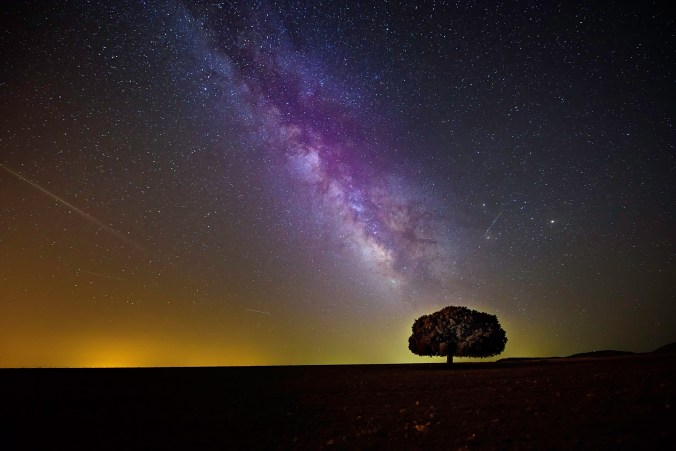
as if the stars cannot
rearrange themselves in the sky
for us; as if
they, you and I,
all known things
aren’t in constant states of motion,
learning and unlearning.
Stars coalesce, are born,
then die and scatter,
its matter mingling with matter
from other dead stars,
coalescing into newer,
denser stars,
the cycle renewed in timelines
beyond our real-time observation.
Our sun is at least
a second-generation star
in this manner,
and the world of me and you
thrives on its energy.
This is how you and I came to be,
and yes, we are
but sentient star remnants
in constant motion.
That’s how you and I
came to coalesce.
It takes four years
for the light of the next
nearest star to reach
the solar system of
me and you.
The twinkle we shared when we first met
began its journey way back when
you and I were still clinging to
dying systems separately, orbiting
resentment and dysfunctionality
until implosion.
And yet for that random twinkle to mingle
with the twinkle in our locked eyes that night
as we danced to Earth, Wind & Fire,
the elements conspiring us to groove together,
shifting constellations of past lives,
don’t you dare tell me that me and you
didn’t move the stars themselves to
make this fusion happen.
***
I’ve found this one rather useful in trying to ‘surprise’ myself into writing something I wouldn’t have come up with otherwise. Today, I’d like you to take one of the following statements of something impossible, and then write a poem in which the impossible thing happens:
The sun can’t rise in the west.
A circle can’t have corners.
Pigs can’t fly.
The clock can’t strike thirteen.
The stars cannot rearrange themselves in the sky.
A mouse can’t eat an elephant.
Happy writing!
I feel like I cheated a bit, as the stars are in constant motion, but this motion is mostly beyond our limited powers of perception, but hey, it counts.
Our prompt for the day (optional as always) takes its cue from Notley’s rebelliousness, and asks you to write a poem that involves rebellion in some way. The speaker or subject of the poem could defy a rule or stricture that’s been placed on them, or the poem could begin by obeying a rule and then proceed to break it (for example, a poem that starts out in iambic pentameter, and then breaks into sprawling, unmetered lines). Or if you tend to write funny poems, you could rebel against yourself, and write something serious (or vice versa). Whatever approach you take, your poem hopefully will open a path beyond the standard, hum-drum ruts that every poet sometimes falls into.
Ironically, I’ve done so much free-verse in the past month that the most rebellious thing I could do right now is to actually stick with a form verbatim, and perhaps incorporate a rhyme scheme too. I used the quatern form and added an “abba-baab” rhyme scheme to enhance my little “rebellion”.
I first saw the quatern on Shannon’s blog post, located here. I told you I’d give it a shot, Shannon!
The path beyond my garden was once concrete, cinderblock, brick, asphalt, and dirt fields that were once meant to be green. On those dirt fields, we played a game called “Kill the Man”, where one kid would try to run with the football from one goal – marked by the faded “keep off the grass” signs – to the other without being tackled by the two-dozen other kids clamoring to clobber him. If the kid got tackled, he’d throw the ball up in the air, and we’d scratch, claw, and elbow each other for the right to possess the ball and be the next runner to be clobbered.
If you scored a goal, your reward was the privilege of trying to make it back through the masses to the other goal. We didn’t keep score. There was no winner. There was only your reputation to defend; your place etched in cinderblock by word of mouth.
I started out as The Professor. That’s what they called me because of my coke-bottle glasses, my nose usually being in a book, and my uncanny math-solving skills that had teachers asking me to participate in the academic Olympics – a request I declined, as I know when adults were gaming kids with more homework, and I wasn’t working overtime for free.
I entered the field as The Professor, but after a few weeks of earning my stripes on that dirt field, they started calling me something else. They marveled at my elusiveness as “The Man”, oooed and ahhed at my prowess in delivering bone-crushing tackles for someone so comically undersized, and they cheered me on as I never quit on a play, even when all others would. They began to call me Superman, which was rather hyperbolic, but I was only Superman on the field, so no big.
Off the field, I was still The Professor, but it was no longer a derisive term. I had friends, I had a best friend, and I even had a crush who I was emboldened enough to write love notes. I knew little of emoting in writing, but I knew enough to plagiarize and reconstruct whole sections of Judy Blume novels to get my point across; chopping and screwing words the way hip-hop DJ’s worked their magic with jazz, funk, and soul.
Her name was Charise Parker. I’m probably safe revealing her name, as this was some thirty-five years and 1,732.91 miles ago, and her fate and familiarity are now foreign to me. But I loved her as much as a ten-year-old could love a girl with his whole heart. She liked me as a friend, but she still blushed at reading my Judy Blume samples, and she let me play jump-rope with her homegirls, which befuddled the boys who played “Kill the Man”.
Her older brother would play catch with me, always throwing the ball much harder than I could catch, always with a wry, crooked smirk on his face. I imagine that if his smile ever showed teeth, he’d disappear like the Cheshire Cat. It was like he knew I was just pretending to be hard, but he didn’t care. As long as his sister liked me, he treated me like a pesky kid brother. And with her, I was almost comfortable enough to show her the parts of me I hid from brick viewpoints.
Almost.
(Aside: My hard-fought place in the universe would eventually be upended by something terrible and completely unrelated to those kids who had given me a seat in the dirt, but that’s another story I won’t get into here.)
I would school hard and play hard, and then come home to momma and Phil and our afternoon/evening routine. In addition to watching cartoons, doing my homework, and helping Phil with his, I was keeping tabs on Baby Fae, the infant with a heart defect, who had her heart replaced with that of a baboon’s. It was supposed to be a miracle of modern medicine.
Medical stuff made me queasy, both then and now, but I voraciously ingested this story. I don’t know why it resonated so deeply with me, but someone so vulnerable and innocent just had to have a happy ending. We were poor and lucky enough to have the lights turned back on recently while Reagan hosted state dinners with the choicest cuts of meat, and J.R. Ewing got away with being a wealthy tyrant every Friday, but I just knew that fate wouldn’t be cruel enough to take away Baby Fae so young.
Obviously, I had a lot to learn about the cosmos not giving a damn about our pain and suffering.
When the news reported her death, I remember curling up in momma’s lap, just a ten-year-old crybaby. I don’t know how long I cried, nor how long momma tried to convince me that the infant was in heaven now, but I what I appreciate most was that eventually, she held me in absolute silence, allowing me my time to grieve for the child I never knew, allowing my vulnerability.
Tomorrow, I would again don the mask that earned my dusty seat at the neighborhood table, but that night, momma held me as I sobbed, and she just let me be me.
snowfall seasoned dirt
the earth beneath me hardened
it will melt in spring
You are the Truth
locked tight in my pocket;
promise kept by my fortuity.
You linger patiently,
meeting my frailties with loyalty
pouring into my cracks.
You stay,
voice soothing my raspy song,
facing, leaning into my calm.
Your will
driving intent to fill my silent plea.
I feel this,
your tacit strain
as you heal my wounds.
You’re afraid to leave
without securing my trust
where I live on abyss’s edge.
You steadily shatter delusions
trumpeting your presence
crossing my boundaries.
But I am not here
can’t be found in the light;
cocooned twilight.
You join our hips
expanding as I contract,
filling void with familiar
you still see me where I live.
***
Our prompt for the day (optional as always) isn’t exactly based in revision, but it’s not exactly not based in revision, either. It also sounds a bit more complicated than it is, so bear with me! First, find a poem in a book or magazine (ideally one you are not familiar with). Use a piece of paper to cover over everything but the last line. Now write a line of your own that completes the thought of that single line you can see, or otherwise responds to it. Now move your piece of paper up to uncover the second-to-last line of your source poem, and write the second line of your new poem to complete/respond to this second-to-last line. Keep going, uncovering and writing, until you get to the first line of your source poem, which you will complete/respond to as the last line of your new poem. It might not be a finished draft, but hopefully it at least contains the seeds of one.
I wasn’t too keen on this prompt, so I tweaked it a bit. Instead of finding an unfamiliar poem/poet, I found an extremely familiar one to me. I chose a poet I admire, a frequent collaborator, and a good friend, Tre. The poem I used as a reference is titled The One I Spared. I encourage you to head over and read her exquisite work.
Yesterday, me and Wifey traveled from Whistler back home, and today I had a talk therapy session, so I’m a day behind in my poetry. Perhaps I can squeeze out another one later.
The path beyond our truths
is paved by her
vulnerability,
gifted only to me
as promissory note
in exchange for my own
implied promise
of confidence,
an intimate currency
shared between us,
and as proud as I am
as sole recipient
of these treasures,
as beneficiary
of her hopes, fears,
triumphs, and demons,
as tempted as I am
to squander her gifted windfall,
sharing this wondrous woman’s gems
with the rest of the cosmos,
I know enough
to enjoy and appreciate
her gifts
in reverent silence,
for her priceless confessional
can never become
just another
cut-rate anecdote.
***
Written for NaPoWriMo Day 17 prompt: “write a poem re-telling a family anecdote that has stuck with you over time.”
As someone who dabbles in confessional poetry far too often, I probably default to anecdotes all the time. While I enjoyed this prompt, this was also a perfect opportunity to zig instead of zagging.
…write a poem in which the words or meaning of a familiar phrase get up-ended. For example, if you chose the phrase “A stitch in time saves nine,” you might reverse that into something like: “a broken thread; I’m late, so many lost.” Or “It’s raining cats and dogs” might prompt the phrase “Snakes and lizards evaporate into the sky.” Those are both rather haunting, strange images, and exploring them could provide you with an equally haunting, strange poem (or a funny one!)
In all honesty, this prompt left me a bit lost. When I tried in earnest, I was left writing nonsensical garbage. I didn’t give up though; I shifted focus and tried writing about a known event between consenting adults in a new way. It’s not quite up-ended, but I’m ok with the result.
The path beyond the garden hidden among evergreen titans rises and falls on gentle sloping hills that seem to roll upon each other like sleepy lovers playfully jostling for their share of the asphalt blanket. The rain, ever present in a fine mist, tamps down much of the troublesome pollen, while simultaneously opening the senses to pine, fir, rhododendrons, and that smell that smells of renewal; the smell that shocks the lungs into expanding to take in as much as possible.
Children play at the end of the cul-de-sac with a sense of oblivious urgency as they sketch in chalk the scaffolding of worlds only they understand, their shrill voices, quaint little bells of amusement amid mild relief that they’re someone else’s problem as long as the squeals don’t turn into sobbing. Kids at play yield to love songs performed by the neighborhood bird choir, who then yield the stage to the sunset, next then a frog symphony, and if you’re extremely lucky, an owl or two might quiz you.
The path curves, rises, winds, and falls, weaving between tree line and homestead, painting unhurried, sleepy tracers from where love lives to where she wanders to prove herself. She need not travel far; all that is needed is within reach. It is a wondrous balance, living inside a temperate rainforest that hosts a town that hopes to remain sleepy; remote enough to be considered a hassle to visit, and yet somehow, at the center of all that matters.
green giants shush me
it’s the wind rousing the trees
yielding their secrets
***
Written for NaPoWriMo Day 12 prompt: Oh yeah! Stop! Haibun-Time!
Today, we’d like to challenge you specifically to write a haibun that takes in the natural landscape of the place you live. It may be the high sierra, dusty plains, lush rainforest, or a suburbia of tiny, identical houses – but wherever you live, here’s your chance to bring it to life through the charming mix-and-match methodology of haibun.
Anyone who’s been sniffing around this blog from the beginning knows how much I love writing haibun. Still, I’m glad there are no haibun police, as I’m a habitual haibun rule-breaker. I think I did ok with this one.
The path beyond my garden is knotted and
frayed at the edge where our overgrowth tumbles
onto boundaries between us and them.
No major action taken thus far by us,
the current owners, to curl back the
photosynthesized nonsense from the
well-manicured landscape of our neighbors
– that is, outside of
assassinating a few weeds
– well, wifey does that part,
as I’m fortunate enough to have
asthma’s hacking fits, and the man-child
who still honors us with rent-free company
over-promises and delivers but a
lukewarm token hack-job, earning him no pay.
Best leave killing for the pros, anyway.
No matter though, as wifey has enough
murder in her heart for thugged-out weeds,
shriveled plants that were once treasures, and
even the poor trees guilty only of being
rooted in the wrong place at the wrong time, as
she hacked down the sturdiest foliage planted
too close to home to be considered safe
– actually, for this part she mostly
hired contract killers, but she may as
well had pulled the trigger herself.
While watching from the safety of the living
room, I successfully pleaded for the life
of the largest tree landmarking the edge
of our property with the biggest spring blossoms,
the sturdiest leaves that clutter the driveway
in autumn, and – basically, it lives as
the tree wifey swears at the most.
She spared this tree because I enjoy
looking at it from our living room window.
This slob-of-a-tree and a few Rhododendron
– or Azaleas, because Christ – put a gun to my
head and I still couldn’t tell the difference
– are all that remain from what was once a
thriving botanical garden of what wifey called
ugly plants that deserved to die.
But she spared my messy-ass tree, and
kindred spirits make for good company.
I bet the neighbors miss the previous
gardeners as much as the slain garden,
especially in the back yard, where it looks
like zephyr invited squall and tornado
to a rave, leaving behind pine-needle
confetti as neighboring trees litter
their dead-weight over the fence into our
yard in the form of broken branches.
They don’t know how lucky they are to have
been planted on the other side of our fence.
***
Written for NaPoWriMo’s Day 4 prompt, and I’ll just quote the prompt from the site:
Today, we challenge you to write a poem that is about something abstract – perhaps an ideal like “beauty” or “justice,” but which discusses or describes that abstraction in the form of relentlessly concrete nouns.
This was easily my favorite prompt thus far. I don’t know if my effort measures up, but I relished the challenge.





 Hephaestus’ Waste & Cosmic Rubble